Supporting Creative Expression through Process Art

Child's hand drawing colorful scribbles with a handful of crayons

Creative activities can be a joyful experience for young children. The child can focus on creating, examining materials, and developing skills. Young children benefit from creative opportunities that allow unstructured time for exploration and self-expression. This approach encourages creativity, fine-motor development, planning, critical thinking, problem-solving, communication, imagination, emotional expression, and relaxation.

Often, the best way to encourage children to engage in process-focused art is for adults to offer a variety of materials and see what happens. Examples may include painting, sensory art activities, construction, design, clay, weaving, beads, stamps, collage, or drawing. Allow the child to come and go from their art, providing plenty of time for children to explore. For supplies, consider nature objects, recycled materials, loose parts, glue, scissors, paper, markers, paints, homemade dough, cloth, string, and other interesting materials.

Even as your young artist directs their own experience, adults can contribute by asking open-ended questions based on what they see the child doing. Open-ended questions are inquiries that do not have a simple “yes” or “no” response. Instead, they prompt children to think about their process, try to explain in their own words, and consider encouraging next steps they can to try out.

Can you think of another way?

What might you try instead?

What can you tell me about…?

What does it remind you of?

What does this make you think of?

What would happen if…?

What do you think would happen if…?

How did you think of that?

What can you tell me about the things you have?

What are you going to do with that?

Can you show me what you could do with it…?

Is there anything else you could use?

Process art is different from project art, which is adult-led, has guidelines and instructions, and usually only one outcome or final product in mind. Process art emphasizes expression, experimentation, and exploration. By providing a variety of materials and lots of time, the child can focus on their experience and create whatever they want, which is valuable for increasing confidence and autonomy.  

Need some fun ideas for process art with young children? Check out what children’s librarian Jaime at LearnPlayRead offers on her website. Merri Cherry also has 50 activities for kids that you might get some inspiration from. One of my favorite activities is Play-Doh in a variety of colors. Need a recipe for a no-cook version? Check out Laura Tuck’s recipe on the Inspire My Play website.

If you are feeling left out, remember that process art is not just for littles! Try out some fun exploration with materials yourself!

You are an explorer. You understand that every time you go into the studio, you are after something that does not yet exist.”
― Anna Deavere Smith, Letters to a Young Artist

Aoife Rose Magee, PhD, earned a doctoral degree in Special Education from the University of Oregon Early Intervention Program. Her personal and professional interests have been largely focused on the social-emotional development of young children and how positive parenting and teaching practices may contribute to healthy development, promote resiliency, and mediate risk factors. Aoife is professional development specialist for students and practitioners in the areas of Early Childhood Education, Early Intervention/Early Childhood Special Education and Parenting Education.  Aoife serves as a Master Trainer for the Oregon Registry and frequently provides community based and private workshops for early childhood educators, parenting educators, and other professionals. For more than thirty years, she worked directly with families as a parenting educator, and she is a former Oregon Parenting Education Collaborative Hub Coordinator for the Parenting Success Network. She currently teaches as a full-time faculty in the Early Childhood Education Program at Lane Community College. She is also the mother of a fantastic young adult son and enjoys nature and creative pursuits in her spare time.
Getting Creativity Flowing with your Elementary Schoolers

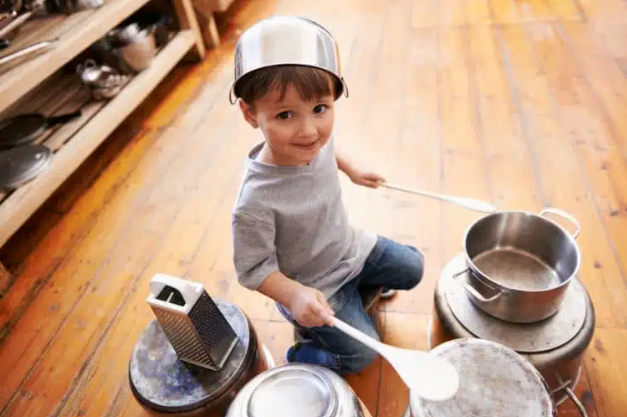
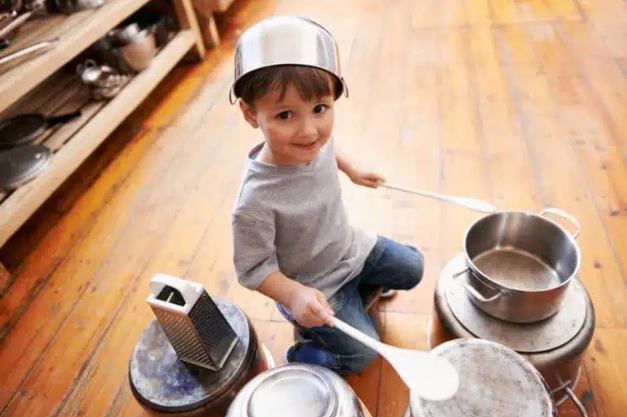
Child creatively drumming on pots and pans with a pot on their head

Giving your children opportunities to express their natural creativity enhances their brain development. When they have fun expressing themselves with activities like music, arts, and crafts, they learn to actively solve problems and look at situations in new ways. Creative expression is an important part of life! The arts provide opportunities to explore culture and develop thinking, communication, and social skills. Music promotes number and language skills. It also helps children develop rhythm, melody, and timing and is naturally calming. Drama and acting develop spoken language. Drawing and creative movement activities like dance help develop fine and gross motor skills. Encouraging and providing opportunities for creative expression helps develop confidence and healthy self-esteem. Through the arts, children learn more about their world!

It is important to focus on the process of creative expression, rather than the result. With practice, curiosity, and repetition, their skills will develop over time. The pure pleasure of putting crayons to paper, or manipulating a blob of clay in their hands is something to enjoy. Try to keep judgments out of your comments to your child. Instead, describe what you see and ask open-ended questions. For example, “There is a lot of red in your picture, can you tell me about your drawing?”

Creative expression can help children access and articulate their feelings. It may be easier to draw a picture of how they feel than to talk about it. You may hear them work out conflicts or challenges through their creative play. By expressing themselves through art, music, or drama, children can try out new ways of thinking and problem-solving, and sometimes come up with creative solutions.

How to Encourage Your Kids to be Creative Notice activities your child shows interest in

Often, things that our kids are interested in come out during playtime. Pay attention to repeated activities that they do during play times to see what might spark their creativity. If your child is always strumming on their toy guitar and banging on pots and pans, see if they are interested in a local music class. If they love to move their bodies any time a song comes on the TV, a dance group might be fun! Joining a group or class can be a way of encouraging and expanding their interest and skills.

Let your child try different things

You might find that the first activity you try isn’t the one your child is passionate about, and that’s all part of the learning process! Continue to pay attention to what they’re showing you they like through their play, and with time you’ll find creative activities they enjoy. Practice is how kids (and adults!) grow their confidence, so if you find something they enjoy, try to stick with it for a little while to see your child grow and thrive with a new, fun skill being developed. When you encourage your child to stick with an activity, even when it seems hard at first, you are building resilience!

Encourage your child’s interests

Incorporate creative play into your regular routine with your child. This could look like painting and coloring, singing and dancing together, playing dress up, and making up silly stories. Find whatever works best for your family!

When you’re out and about, make a point to talk about things around you that you find beautiful. Is there a building you pass on the way to daycare that has a beautiful mural? A cherry blossom tree that blooms near your house and creates a pink floor on your walks? Point out details such as colors, lines, and textures. This helps your child see the world through a creative lens!

And encourage your child’s attempts!

If you’ve put your child in music lessons to learn to play the violin, show an interest in it by listening to them play! When they bring home artwork they made at school, talk about what they love about it and hang it up for the family to enjoy. Try to avoid any criticism, such as “Dogs aren’t supposed to be taller than houses!” Let your kids express themselves freely, and give plenty of praise for trying hard and learning new skills!

Creative hobbies are excellent for self-expression, self-confidence, and connection with others who share the same interests as your child. Creative activities can be a source of pleasure and pride for many children and parents, and an enriching part of life!

Fun Fall Crafts!

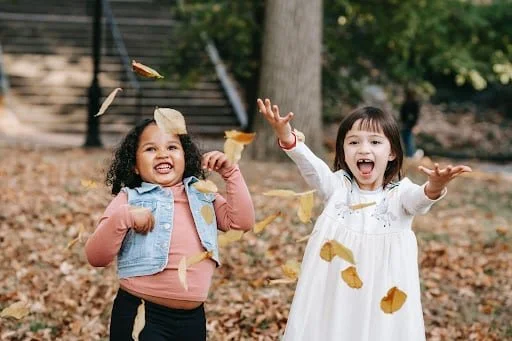
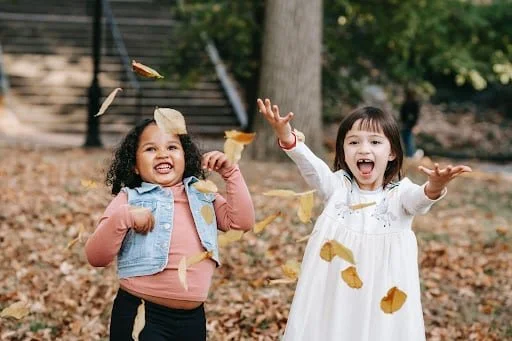
Two children joyfully throwing autumn leaves in the air outdoors

The leaves are falling, school is in full swing, and the weather is changing! This season brings about a lot of change, including keeping your kids indoors more with the rain and cold. Try one of these fun fall crafts to keep them – and you! – busy on your next rainy Sunday inside.

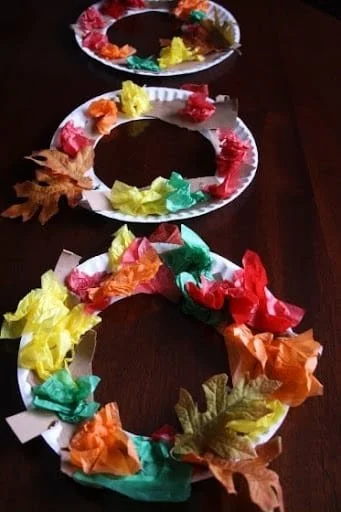
 PAPER PLATE WREATHS

Making paper plate wreaths is fun, simple, and a good way to get creative with your kids.

You will need:

  • Paper Plates

  • Different colors of tissue paper

  • Gluestick

Using child safe scissors, help your child cut out the center circle of a paper plate. Set the center circle to the side (you can use this to color on later!), and select a few different colors of tissue paper. Have your kids crumple up little pieces of the tissue paper, put some glue on the outer plate ring, and stick the tissue paper on it. Repeat all the way around the plate until your child has a beautiful, colorful wreath for Autumn!

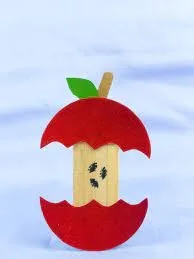
Popsicle Stick Apple Cores

These are so cute, quick, and easy to make!

You will need:

  • Popsicle sticks

  • Green, red, and brown construction paper

  • Glue

  • A black pen or marker

Help your child cut green and/or red circles, then cut those in half with child safe scissors. Cut brown rectangles, and green ovals for leaves. Help your child glue three popsicle sticks side by side to create the core, then have them place the other pieces and glue to the popsicle sticks. Help them color on seeds and you’re finished!

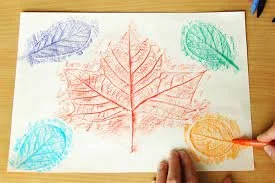
Leaf Rubbings

Your curious nature lovers will enjoy this activity! Part art and part science, your kids will learn about nature while creating their own colorful leaf.

You will need:

  • Leaves! Different shapes and sizes make this activity even more fun.

  • Tracing paper or parchment paper

  • Crayons

  • A hard surface (a table or clipboard)

Have your child pick a leaf and place it on a solid surface. Cover the leave with the parchment or tracing paper, and slowly and steadily rub crayons over the top of the paper to reveal the outline and details of the leaf. Your child will be so excited to see their leaf brought to life on paper!

Once you’re all done with your crafts, display them somewhere for the whole family to see, your child will be so proud to see their work hung up. Kids love to make crafts that you can display in your home for them to see often!

Creativity Is All Around You

Grandparent teaching a child to play guitar together at home

There are all sorts of ways to encourage your child to express their creativity. Performance arts, such as dance, acting, or playing an instrument all begin with your baby moving to music or rhythm, or your toddler’s first games of make-believe. Visual arts like coloring, painting, drawing, using markers or different types of paints start with your child experimenting in a variety of mediums. Woodworking, sewing and design have their roots in block play and letting your child choose their clothes for the day. Storytelling and poetry, rhyming and songwriting all begin with encouraging your child to use their voice to tell the story of what happened, doing finger plays and singing together. Creativity is all around you and your family! 

One of the first steps in helping your child get creative is to give them a wide variety of experiences and exposure to different types of expression. It is important to let them tell you about what they have created or done, and to describe what you see. For example, “You really used a lot of red in your picture. Tell me about what you have drawn.” When we avoid putting our judgements on their creation (i.e. good, beautiful) it will be a true expression of themselves, rather than them learning to do it “right” or to please you.

Ask them if there are any types of art they are interested in learning or practicing. By giving them many “tastes” of different activities, they can figure out which activities and mediums they enjoy and would like to do more of. 

If your older child is showing an interest in learning a certain type of art, help them get involved and show them the process. Sometimes, children just want to do something but don’t understand how time consuming it might be or what is involved exactly. You are your child’s best resource of knowledge. If your child is interested in something that involves equipment or materials, take your child with you to go and see the equipment or go and find the materials. If it is out of your price range, see if your school, neighbors, or a company has access to the equipment or materials, even if you have to rent it.

Just because your child is interested in one activity doesn’t mean that they will stay interested in that activity. Remember, your child is still learning about the world around them and they are trying to figure out what they like and what they don’t like. This is a time for them to explore. 

One of the ways to instill resilience in our children is to encourage them to follow through on their commitments. We want to encourage persistence when an activity is challenging, so sticking with the activity is important. Sometimes this takes lots of encouragement from us, like, “you can do it!” If your child is feeling discouraged, talk it through and support them to share their feelings. When we can name our feelings, it helps our brain be able to regulate and we can stay calm and access our creative mind. Take a break and try again. Confidence comes with practice over time. Self confidence comes with being proud of what you can do, which takes practice and persistence.

Try to keep the focus of any creative activity on the process or experience rather than the outcome or product. We know that we will stick with an activity when it is enjoyable. This leads to more practice and experimentation, which over time leads to mastery. Creative expression helps your child integrate their experience of the world into their brain and make sense of their emotions. 

Some ways to help your child find an activity that will help them develop their creativity is taking your child to go and see a variety of ways others express themselves. If your child is interested in dance, attend a local performance, or sit in and watch a dance class.

Have a dance party together as a family and enjoy the rhythm of the music, the melody and harmony, or the timing. Sing along and have fun together! Try different types of music to see if your child likes one type of music over another. Have a make-believe day as a family and dress up. This encourages dramatic play.

Try going on a walk and talk about all the details of the world you see. These details will help you understand what your child sees and what else you can help them discover. Does your child see the pattern of trees or a bug floating on the breeze? What color are the leaves during different times of the year? When you return home, they can create a picture of what they saw, act out the movement of the leaves in the trees, or make a rhyme using what they saw.

There are many different museums and galleries in our community. Take your child to a gallery and talk about what they see and what feelings it may evoke for them. Since children learn and experience the world with their whole body, you will need to remind them to keep their hands to themselves, and that it is important to respect what other people have made by looking with our eyes only, not our hands. This experience might spark ideas for other creative outlets to try as a family. Taking your child with you to plays, concerts and performances will also spark creativity.

Going outside the norms and trying different types of art are not only fun for your child but also fun for your family. Remember, creativity is all around you and is something new for you and your child. Have fun together!

This article is brought to you by Parenting Now Parenting Educators and authors. Parenting Now offers parenting groups and drop-in programs for families with children 0-8, and is passionate about fostering happy, healthy families. For more information about Parenting Now please visit their website (https://parentingnow.org/) or contact us at info@parentingnow.org.

Triple P – Positive Parenting Program

Are you interested in receiving more parenting advice? Triple P Online – Positive Parenting Program could be for you! This online parenting program allows you to take a parenting class in the comfort of your own home!

If you live in Lane County, you can get Triple P Online for free by filling out the form on the Triple P page. A staff person from Parenting Now will send you an access code within 24 hours and you’ll be able to start using the program right away! For more information about the program and to sign up visit the Triple P page.

Indoor Crafts For Rainy Days

Guest blog by Kalina Glover Moresi

The winter months can be challenging for restless toddlers. The weather has most families inside, which can make it difficult to keep your child entertained on those cold, rainy days.

If you’re feeling in a rut, here are some ideas to engage your child and have some crafty fun together!

Paper SnowflakesMaterials:

  • White paper – computer paper is the easiest

  • Scissors

Instructions:

  • Fold the paper in a simple way. Young kids can make beautiful snowflakes with a piece of paper folded into fourths.

  • With adult supervision cut the paper on the edges and in funny directions.

  • Open the paper up to see your fun and festive snowflake!

Paper Hearts

Materials:

  • Colored Paper

  • Markers or crayons if you want

  • Scissors

Instructions:

  • Fold paper in half

  • Draw half a heart shape on the piece of paper where the fold part of paper is.

  • Cut out on the line

  • Ask your children what they are thankful for and decorate your house with all the hearts.

Kool-Aid Soft Dough:

Materials:

  • 2 mixing bowls

  • 1 cup of salt

  • 1 cup of water

  • 2 cups of flour

  • 1/3 cup of oil

  • 1 package of Kool-Aid

Instructions:

  • Together with your child, measure and pour the flour and salt into the first bowl and mix.

  • Pour the oil, water and Kool-Aid into the second bowl and mix thoroughly.

  • Pour the liquid mixture into the flour mixture and mix and squish until you have soft dough.

This article is brought to you by Parenting Now! Parenting Educators and authors Amanda Bedortha, Claire Davis and Lynne Swartz, and consultant Jay Thompson. Parenting Now offers parenting groups and drop-in programs for families with children 0-8, and is passionate about happy, healthy families. For more information about Parenting Now! please visit their website or contact us at info@parentingnow.org.

Triple P – Positive Parenting Program

Are you interested in receiving more parenting advice? Triple P Online – Positive Parenting Program could be for you! This online parenting program allows you to take a parenting class in the comfort of your own home!

If you live in Lane County, you can get Triple P Online for free by filling out the form on the Triple P page. A staff person from Parenting Now will send you an access code within 24 hours and you’ll be able to start using the program right away! For more information about the program and to sign up visit the Triple P page.

Exercising Your Child’s Creativity Muscle

Kids are naturally creative, and your unique child is going to express their creativity in their own special way. Some kids express themselves through singing; others like to smear paint all over a canvas; and some kids like to make patterns out of items found in nature. Point is, it’s ALL good and it’s ALL creative. Sometimes parents wonder whether they are doing enough to expose their kids to “the arts.” But you don’t need trips to Broadway or The Met to spark your child’s imagination. Truth is, creativity takes many forms and can be nourished at home using simple materials and encouragement from you! 

Creativity in the home and community

Curiosity can lead to creativity. What will happen if I mix these two colors of paint together? To spark creativity, encourage your child to experiment with a variety of materials. What sound does rice make in a bottle? Is it different or the same as the sound beans make? Remember, the process is more important than the product when it comes to creative pursuits. The joy is in creating!

  • Have crayons, paints, clay, blocks and other supplies to make pictures, collages, buildings. Dig into the recycling bin and get out the paper, scissors, string and glue and let them have at it!

  • Use pots and wooden spoons for percussion instruments or have your child try out a guitar or recorder if you have one (supervised).

  • Go to the park and point out the different shapes of leaves, different colored flowers, patterns on the bark of a tree. Have your child make patterns with pebbles.

  • Walk around your neighborhood and notice the different colors of houses. Notice the shapes of street signs. Look for neighborhood murals or even graffiti.

  • The community is filled with outdoor sculpture, fountains, murals, festivals and other creative opportunities. 

Be supportive and encouraging

Children love to share their creations. You can be a good audience by being attentive when they ask to show you their drawing. Take pictures of their creations, and share with grandparents or friends. In addition you can:

  • Encourage your child to try out different things – are they most interested in music, drama, painting, or writing (for older children)?

  • Remind yourself that children’s interest can change quickly and easily-don’t let it get to you. When you follow their interest, you are letting them know that what they make or do is important, they have good ideas, and they are important.

  • Encourage your child to share, but don’t force them to perform, especially in front of others they may not know well or when they are feeling shy.

  • Find activities that encourage pride in your cultural or ethnic, racial, or religious identities.

  • Introduce your child to artwork, dance, music, and more that comes from diverse communities, while being respectful of the meaning of these activities to the particular culture.

  • Proudly display your child’s art: hang up artwork; take photos of dance performances; record their music. Some families have a special frame in a place of prominence where they display and rotate their child’s artwork periodically.  Not only will they see how proud you are of their efforts, but you will also be creating wonderful memories for the future for you and for them.

Children can and do learn from creative arts. It needn’t be fancy or formal, but it can easily be part of every day whether it’s a collage made from sticks from the park, a formal tot ballet class, or singing in the bathtub. Encourage your child to find what sparks their interest  and gives them enjoyment now and they will enjoy a creative mind throughout their lives. 

This article is brought to you by Parenting Now Parenting Educators and authors Amanda Bedortha, Claire Davis and Lynne Swartz, and consultant Jay Thompson. Parenting Now offers parenting groups and drop-in programs for families with children 0-8, and is passionate about happy, healthy families. For more information about Parenting Now, please visit their website or contact us at info@parentingnow.org.

Triple P – Positive Parenting Program

Are you interested in receiving more parenting advice? Triple P Online – Positive Parenting Program could be for you! This online parenting program allows you to take a parenting class in the comfort of your own home!

If you live in Lane County, you can get Triple P Online for free by filling out the form on the Triple P page. A staff person from Parenting Now will send you an access code within 24 hours and you’ll be able to start using the program right away! For more information about the program and to sign up visit the Triple P page.

STEAM in the Kitchen

Cooking and baking alongside your toddler and young child results in so much more than just a tasty meal or snack! When we cook with our child, we provide opportunities for learning science, technology, engineering, art, and math (STEAM). STEAM is a way of looking at learning that explores many subjects within the same activity—and your kitchen is the perfect place to explore these ideas and have fun doing so! Cooking, by nature, is all about scientific reactions—the way cornstarch thickens soup, or yeast helps bread dough rise. But it can also be about making food art, or engineering the tallest sandwich tower! When you do a cooking project, ask your child to guess what they think might happen. Then observe how it turned out. Becoming a master of anything begins with curiosity, and cooking is all about experimenting with flavors, textures and colors. Measuring, pouring, stirring and watching food grow and change are all about math and science, but also spark creativity and artistry. And don’t we want learning to be fun?Here are some ideas for teaching STEAM using food:

Watermelon Volcano Experiment:

Just in time for summer, turn a watermelon rind  into an exploding volcano (after you save the red, ripe delicious insides for a snack, of course)! Supplies:

  • Small watermelon

  • Baking soda

  • Vinegar

  • Dish soap

Steps: Carve your watermelon like you would a pumpkin, cutting a small hole in the top (just big enough so that you can get your hand into it. Then, scoop out the watermelon insides so the watermelon is hollow—save your watermelon for snacks later! Then, pour ½ cup baking soda into the watermelon, followed by a few drops of dish soap. The fun really begins when you pour in the vinegar and your watermelon volcano “explodes”!

Ice Cream In A Bag:

Making your own ice cream is a great way to get the whole family moving and shaking—and cool off during hot summer days. Supplies:

  • 1 tablespoon sugar

  • ½ cup Half & Half

  • ¼ teaspoon Vanilla Extract

  • ½ cup table salt

  • 4 cups of ice cubes

  • Small, sealable sandwich bags

  • Gallon-sized freezer bags

  • Oven mitts

Steps: In a small sealable bag, add 1 tablespoon of sugar, ½ cup of Half & Half, and ¼ teaspoon Vanilla Extract. Set aside.In a gallon size sealable bag, add 4 cups of ice cubes and ½ cup of salt. While still sealed shut, place your small bag of sugar and milk into the large bag of salt and ice. Seal the bag.Wearing oven mitts, shake the bags for 5 minutes. Then, the ice cream is ready to eat!

Fruit Rainbow:

Fruits and vegetables are full of beautiful colors—and taste good too! Have a fun, and yummy time with your kiddos making a fruit rainbow. Supplies:

  • Strawberries (Red)

  • Oranges or golden raspberries (Orange)

  • Pineapple (Yellow)

  • Green grapes (Green)

  • Blueberries (Blue)

  • Purple grapes (Indigo and Violet)

  • Plain yogurt

Prepare your fruit by washing it and cutting the strawberries, oranges, pineapple, and grapes into ¼ size bites. Assemble your rainbow by following the sequencing of rainbow colors “ROYGBIV”:  red, orange, yellow, green, blue, indigo and violet. At the ends of your rainbow, add a few dollops of plain yogurt for clouds. Enjoy!

Fun in the kitchen

“Some people like to paint pictures, or do gardening, or build a boat in the basement. Other people get a tremendous pleasure out of the kitchen, because cooking is just as creative and imaginative an activity as drawing, or wood carving, or music.” — Julia Child

There are so many ways to look at cooking through a STEAM lens. And whether your child is a toddler or a tween, there are lots of age-appropriate activities for using STEAM in the kitchen. Enjoying time doing a STEAM learning activity with your child builds lifelong memories and sparks their passion for learning through fun and creativity.

This article is brought to you by Parenting Now Parenting Educators and authors Amanda Bedortha, Claire Davis and Lynne Swartz, and consultant Jay Thompson. Parenting Now offers parenting groups and drop-in programs for families with children 0-8, and is passionate about happy, healthy families. For more information about Parenting Now, please visit their website or contact us at info@parentingnow.org.

Triple P – Positive Parenting Program

Are you interested in receiving more parenting advice? Triple P Online – Positive Parenting Program could be for you! This online parenting program allows you to take a parenting class in the comfort of your own home!

If you live in Lane County, you can get Triple P Online for free by filling out the form on the Triple P page. A staff person from Parenting Now will send you an access code within 24 hours and you’ll be able to start using the program right away! For more information about the program and to sign up visit the Triple P page.